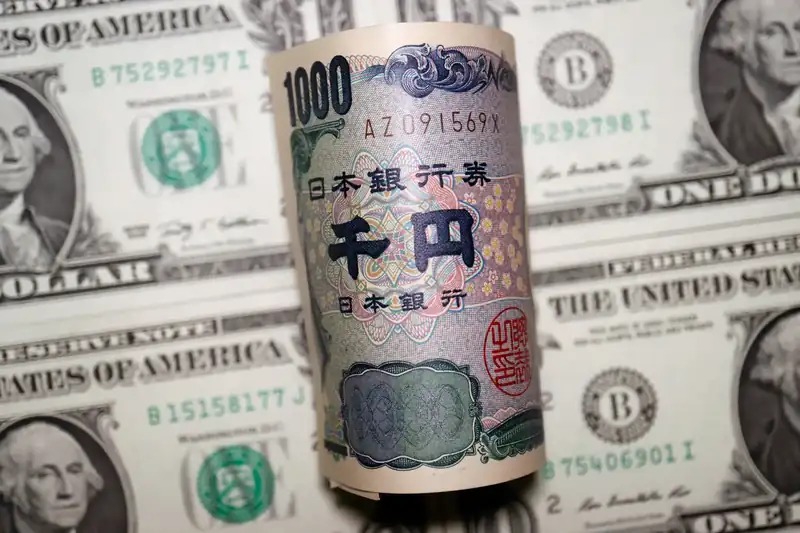
The Japanese yen has experienced its largest weekly decline in over two months, as the dollar strengthened amid renewed inflation concerns and geopolitical tensions. Analysts suggest that potential interventions by Japanese officials may have limited long-term effects without coordinated measures such as rate hikes by the Bank of Japan (BOJ).
Markets have ruled out any chance of a rate hike from the BOJ at its upcoming policy meeting, according to LSEG data. The dollar index, which measures the greenback against a basket of currencies, rose 0.01% to 101.46, marking a 0.7% increase for the week. Against the yen, the dollar weakened slightly by 0.02% to 163.81 but was up nearly 0.9% for the week, its strongest performance against the yen since May 15.
The dollar's recent rise is attributed to renewed strikes in the Iran war, which have reversed oil prices and reignited inflation fears. This has bolstered expectations that the U.S. Federal Reserve may hike interest rates. U.S. crude fell 3.47% to $88.99 a barrel, while Brent dropped to $96.48 per barrel, down 4.12% on the day. Expectations for a Federal Reserve rate hike at its meeting next week have increased to 35.8%, up from 12.8% a week ago.
“It's not surprising that dollar-yen has gone up under the conditions that we're facing. It's a low-yielding currency facing a terms-of-trade shock with higher oil prices.”
Thierry Wizman, Global FX & Rates Strategist at Macquarie Group
Michael Feroli, chief U.S. economist at J.P. Morgan, noted that while he expects the Fed to leave rates unchanged at the next meeting, there may be at least two hawkish dissents due to ongoing inflation concerns. Meanwhile, the euro slipped 0.06% to $1.1369, down nearly 0.6% for the week, following the European Central Bank's decision to leave interest rates unchanged.
The ECB's chief economist, Philip Lane, stated that the current inflation shock is considered medium-sized, requiring some policy action but not aggressive moves. Traders are pricing in a 70.8% chance of a rate hike in September, according to LSEG data.
“Some on the committee are losing patience with above-target inflation.”
Michael Feroli, Chief U.S. Economist at J.P. Morgan
Background
The yen's decline and the dollar's rise highlight the ongoing challenges in global currency markets, influenced by geopolitical tensions and inflationary pressures. Market participants will closely watch the BOJ's policy meeting and the Federal Reserve's upcoming decisions for further cues.
The yen's decline and the dollar's rise highlight the ongoing challenges in global currency markets, influenced by geopolitical tensions and inflationary pressures. Market participants will closely watch the BOJ's policy meeting and the Federal Reserve's upcoming decisions for further cues.