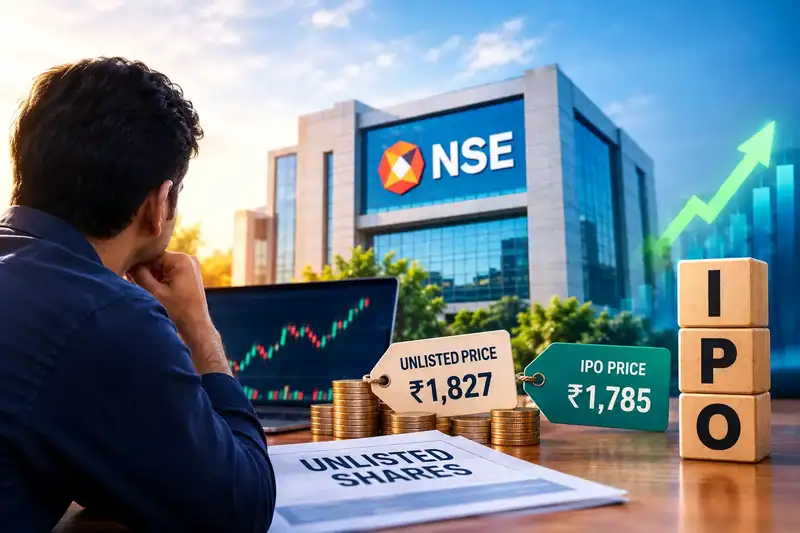
The National Stock Exchange (NSE) of India has set its IPO price band at Rs 1,700-1,785 per share, which is lower than the Rs 2,000-2,100 range anticipated by many investors. This pricing strategy reflects a 15% cut in valuation, aiming to leave room for public-market investors and avoid weak demand or poor post-listing performance.
NSE has been a highly sought-after entity in India's unlisted market, drawing interest from institutions and individual investors alike due to its dominant position in equities and derivatives. The IPO valuation, pegged at around 43 times FY26 earnings, remains at a premium compared to global exchanges but is reasonable against Indian peers like BSE and MCX. The exchange's market position is robust, commanding over 93% of India's cash-market turnover and nearly 100% of equity-futures turnover as of June 2026.
The lower IPO pricing highlights a broader issue for unlisted market investors: the price at which a stock trades before an IPO may not align with its public market debut. This discrepancy was also evident in the case of HDB Financial Services, where the IPO price was significantly lower than its unlisted market value.
“NSE IPO valuation has been cut by around 15%. At around 43 times FY26 earnings, NSE is still valued at a premium to most global exchanges, but looks reasonable versus Indian peers such as BSE and MCX.”
Ishan Tanna, Senior Associate at Ashika Capital
Manish Khanna, co-founder of Unlisted Assets, emphasizes that while the NSE IPO is a reality check, the context is crucial. Even at Rs 2,100, investors are paying an 18% premium to the IPO's upper band, which is not unreasonable given NSE's market position.
The risks associated with buying unlisted shares include limited liquidity, infrequent disclosures, and reliance on eventual listing for exit. The NSE case underscores these risks, as the IPO pricing falls below some unlisted trade levels, serving as a warning to investors.
“Even an investor who bought in at Rs 2,100 is paying roughly an 18% premium to the IPO’s upper band, not necessarily unreasonable for a business with NSE’s extraordinary market position.”
Manish Khanna, co-founder of Unlisted Assets
Background
The NSE IPO pricing strategy is a reflection of the broader challenges faced by investors in the unlisted market, where pre-IPO valuations can often be inflated by hype and scarcity. Previous cases, such as HDB Financial Services, have shown similar patterns, emphasizing the need for caution.
The NSE IPO is expected to attract strong demand due to the exchange's market dominance. However, it serves as a reminder that pre-IPO investing is not a guaranteed profit avenue, and investors should be cautious of the hype and scarcity driving unlisted market prices.