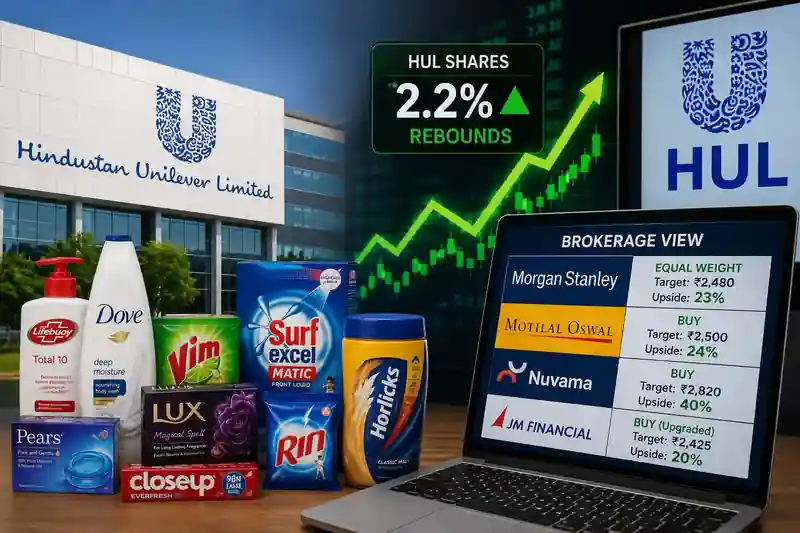
Hindustan Unilever Limited (HUL) reported a 3% year-on-year decline in consolidated net profit to Rs 2,673 crore for the first quarter of FY27, falling short of analysts' expectations. The decline was attributed to a one-off tax credit recorded in the previous year. Despite this, the company's revenue from operations rose 10% YoY to Rs 17,341 crore.
The company achieved an underlying sales growth of 10%, with equal contributions from volume growth and pricing, marking its strongest quarterly growth in 13 quarters. However, the EBITDA margin contracted by 40 basis points to 23% despite an 8% increase in EBITDA to Rs 3,947 crore.
Morgan Stanley maintained an 'Equal Weight' rating on HUL, citing sequentially weaker volume growth as a concern but acknowledging the positive double-digit revenue growth. Motilal Oswal retained its 'Buy' rating, noting HUL's strategic positioning to manage macroeconomic challenges through commodity hedges and cost-saving initiatives.
Nuvama also maintained a 'Buy' rating, highlighting the need for calibrated price hikes due to elevated raw material costs. JM Financial upgraded HUL to 'Buy', emphasizing the positive impact of the new CEO's initiatives on sales growth.
During the earnings call, HUL expressed confidence in its AI-led investments and disciplined pricing approach to navigate raw material price volatility. The company does not foresee significant economic impacts from a 15%-20% rainfall deficit.
Background
HUL's performance in the first quarter of FY27 comes amid a challenging macroeconomic environment, with inflationary pressures affecting raw material costs. The company's strategic initiatives, including AI-led investments and cost management, are crucial as it seeks to maintain its market position and drive growth.
HUL's recent performance and strategic initiatives suggest a potential for market share gains amid inflationary pressures. Investors will be watching how the company leverages its innovations and cost management strategies in the coming quarters.


