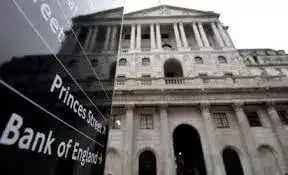
The Bank of England's Monetary Policy Committee decided to maintain interest rates unchanged following a 6-3 vote, while projecting three potential economic scenarios for inflation and growth through 2029. The central bank anticipates inflation to peak at 3.2% in Q4 2026 before declining below its 2% target by Q1 2028, with growth remaining steady at 1.1% annually through 2027.
Under the central scenario, inflation is expected to slow to 1.7% by Q1 2028 and edge up slightly to 1.9% by Q3 2029. Economic growth is projected to accelerate to 1.7% in Q3 2028, moderating to 1.6% in 2029. Oil prices are assumed to decrease from $76 per barrel in Q3 2026 to $71 by the end of the forecast period, while natural gas futures are expected to drop from over 123 pence per therm to under 60 pence.
In a milder scenario, inflation could reach 2.7% in Q4 2026, easing to 2.4% by Q3 2027, and stabilizing at 1.7% in both 2028 and 2029. Growth would remain at 1.1% through 2026, improving to 1.6% in 2028 and 2029. This scenario assumes oil and gas prices are 3% and 6% lower, respectively, than the central projection, reflecting market conditions post the U.S.-Iran memorandum.
The adverse scenario forecasts inflation rising to 3.1% in Q3 2026 and 4.1% in Q3 2027, before easing to 2.8% in 2028 and 2.4% in 2029. Growth is projected at 1.1% in 2026, slowing to 0.9% in 2027, then recovering to 1.6% in 2028 and 1.7% in 2029. This assumes oil prices average 30% above the central projection and natural gas prices remain 60% higher.
The central bank expects only moderate second-round effects on inflation from the energy price shock. The milder scenario anticipates weak demand and a softer labor market preventing broader inflationary pressures.
Background
The Bank of England's projections come amid global economic uncertainties, with energy prices playing a significant role in shaping inflation expectations. The central bank's outlook provides crucial insights for policymakers and investors navigating potential economic challenges.
Looking ahead, market participants will closely monitor the Bank of England's policy adjustments and economic forecasts, particularly in light of potential interest rate hikes by 2027. The evolving energy market dynamics and geopolitical developments will also be key factors influencing economic trajectories.